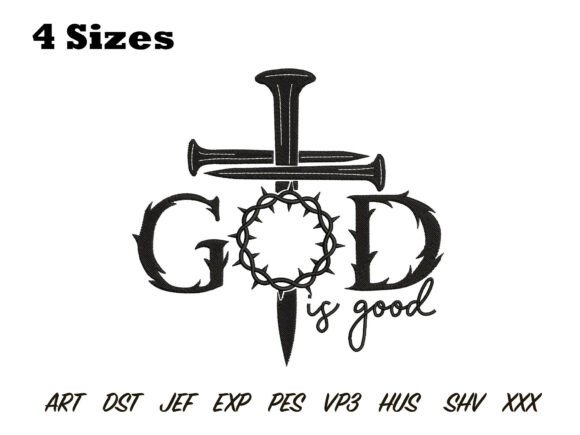
God is Good Embroidery Design
First Impression: Whimsical Charm Meets Quiet Faith
As an embroidery designer who’s prepped over 200 craft fair booths—and watched which designs stop foot traffic dead in its tracks—I opened God is Good Embroidery Design expecting warmth, not weight. And it delivers: this isn’t a stern proclamation or ornate religious motif. It’s playful. Light. Slightly bouncy in rhythm—like a smile tucked into thread. The title alone signals sincerity without solemnity, making it ideal for the modern handmade market where faith meets everyday life. Customers don’t see “Religion” first—they see charm, approachability, and a gentle affirmation that fits right in beside vintage florals and cottagecore motifs.
Where It Shines: Craft Fair-Ready Product Pairings
In my booth setup—tote bags stacked upright, aprons draped over wooden crates, tea towels folded with embroidered corners peeking out—God is Good Embroidery Design stands out strongest on pieces where personality and practicality intersect:
- Tote bag design: Centered on natural canvas or oat-colored linen, it reads clearly from six feet away. The whimsical tone invites conversation—not debate—making it perfect for casual shoppers browsing handmade product tables.
- Apron embroidery: Placed just above the pocket or centered on the bib, it adds quiet intention to a functional item. Buyers love stitching that feels personal but never preachy.
- Tea towel embroidery: Works beautifully on flour-sack cotton or waffle-weave towels. The design’s lightness balances the texture—no drowning in loops or losing legibility.
- Embroidered patch: As a sew-on or iron-on, it’s versatile for jackets, denim pouches, or kids’ backpacks. Its cheerful phrasing resonates across generations.
- Pillow cover & fabric pouch: Small-scale placement (lower corner or centered on a 12” square) gives it presence without overwhelming. Feels intentional, not decorative clutter.
It’s less effective on curved surfaces like baseball caps unless resized carefully—and avoid cramming it onto tiny keychain pouches where letterforms blur. For Etsy sellers and small shop owners, this design thrives in giftable, photo-friendly formats: think rolled tea towels tied with twine, or mini pillow covers styled beside mugs in natural light.
Production Reality Check: What You Need to Know Before Hooping
This machine embroidery design leans into readability and rhythm—not dense fill work—so stitch density is likely moderate. That’s good news for batch production. But don’t assume it’s foolproof. Here’s what I test every time:
- Letter clarity at scale: Small lettering can vanish on textured towels or thick denim. Always run a 3”–4” version on scrap fabric first—especially if using dark thread on dark fabric.
- Hoop size & spacing: If the design spans more than 4.5”, confirm your machine’s max hoop capacity. Tight kerning between “God” and “is” means poor spacing could make it read as “Godis”—a real risk in rushed booth prep.
- Fabric texture vs. thread colors: On terry cloth or heavy linen, use a medium-weight cutaway stabilizer. Skip tear-away—it won’t hold up. And test contrast: soft sage thread on cream linen? Lovely. Navy on charcoal? Might disappear.
- Commercial embroidery readiness: As a digital embroidery file, verify licensing covers finished product resale—especially for Etsy sellers bundling embroidered patches or wholesale aprons. Don’t rely on assumptions.
Visual Impact: Why It Converts at the Booth—and Online
At a craft fair, attention is currency. God is Good Embroidery Design wins because it’s emotionally resonant *and* visually digestible in under two seconds. It doesn’t require decoding, translation, or context—it lands softly, then lingers. That’s rare among faith-based embroidery files.
For handmade product photography, it performs consistently: clean lines photograph well, minimal shading avoids shadow traps, and its positive message encourages shares (“Love this on my market bag!”). When styled with neutral backgrounds and natural light, it elevates perceived value—customers equate thoughtful design with thoughtful making.
Brand-wise, it supports consistency across collections. Pair it with coordinating “Thankful” or “Grace Notes” designs, and you’ve got a cohesive line for holiday markets or spring pop-ups. It also strengthens booth display strength: one well-executed tote + one tea towel + one embroidered patch creates visual harmony—not clutter.
Designer Notes You’ll Thank Yourself For
Before cutting your first production run, do these five things:
- Run a printable mockup alongside actual stitched samples—digital previews lie about texture and scale.
- Stitch a full-size version on your most common fabric: cotton poplin, flour-sack towel, and midweight canvas. Compare thread contrast and stitch definition.
- Check spacing and alignment—especially if offering left/right chest options on t-shirts or aprons.
- Use the right stabilizer for each substrate: cutaway for knits, tear-away for smooth linens, fusible for lightweight patches.
- Create at least one real-world finished product before listing online. Nothing replaces holding a stitched tea towel and seeing how the phrase flows in hand.
Remember: the best embroidery file isn’t the flashiest—it’s the one that stitches cleanly, photographs honestly, and makes customers pause, smile, and reach for their wallet. God is Good Embroidery Design does all three—when treated with intention, not assumed simplicity.