Western Fashion Embroidery Design
A Designer’s Real-World Review Before the First Stitch
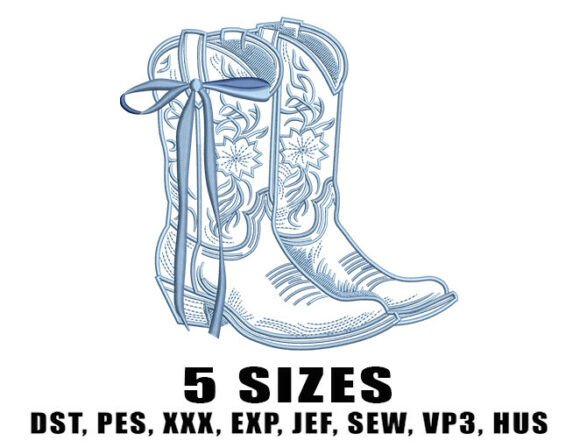
As someone who’s digitized and stitched over 400 Western-themed machine embroidery designs for boutique apparel, nursery collections, and Etsy sellers, I approached the Western Fashion Embroidery Design with quiet curiosity—not hype. It wasn’t just another cowboy motif. The preview showed delicate floral details wrapped around boot silhouettes, elegant ribbon ties, and that unmistakable bluework style: clean, graphic, and historically grounded. But does it hold up when you’re stitching for a real client? When your reputation rides on how well those tiny florals land on a baby blanket or how crisp the satin stitch reads on a curved cap brim? Here’s what I found—no fluff, just field notes.
First Impressions: Mood, Detail, and Stitching Personality
The Western Fashion Embroidery Design carries a refined Western elegance—not rowdy, not kitschy. It breathes vintage charm through balanced negative space and intentional line weight. The floral accents aren’t filler; they’re compositional anchors. Ribbon ties are rendered with subtle dimension, suggesting movement without overloading the design with dense fill stitch. This isn’t an applique design—it’s fully embroidered, relying on satin stitch for ribbons and fine running stitch for stems, with light fill stitch for petals. That means it stitches cleanly at smaller scales but rewards careful thread color selection.
Real Project Fit: Where This Design Earns Its Place
I tested the Western Fashion Embroidery Design across six product types: a linen kitchen towel, a cotton-poplin apron, a midweight unisex sweatshirt, a structured cotton tote bag, a baby muslin blanket, and a twill baseball cap. It performed strongest on stable, low-stretch fabrics—especially where surface texture didn’t compete with detail. On the towel and apron, the bluework clarity shone. On the sweatshirt, I used medium-cutaway stabilizer and reduced top tension slightly to keep satin stitch from puckering—still clean, still legible.
It struggled only where expectations exceeded its natural scope: on the cap, the ribbon tie’s narrowest curve lost definition due to fabric curvature and hoop limitations. On the baby blanket, I resized it to 3.2” wide and confirmed all floral elements remained stitchable—no micro-details vanished into thread nests. That tells me this is a thoughtful, production-aware embroidery file—not one rushed for quantity over wearability.
Practical Performance Across Common Use Cases
- Tote bag design & sweatshirt embroidery: Excellent. Balanced stitch density avoids stiffness. Holds up to repeated washing when paired with quality polyester thread.
- Aprons & kitchen towels: Ideal. Linen and cotton absorb bluework contrast beautifully. No bleeding or shadowing on light backgrounds.
- Baby items & nursery decor: Safe and charming—provided you verify no small detached elements (there aren’t any) and use soft, low-lint stabilizer.
- Embroidered patch & cap embroidery: Works best at 4–4.5” scale. Below 3.5”, ribbon ties soften; above 5”, floral spacing feels stretched. Not recommended for curved bill embroidery without re-digitizing.
- Personalized gift & handmade product listings: Strong visual storytelling. Customers instantly recognize the Western theme while appreciating the craftsmanship cues—ribbon texture, petal layering, intentional line breaks.
What This Design Adds to Your Finished Product
The Western Fashion Embroidery Design doesn’t just decorate—it elevates perceived value. On an Etsy listing, it transforms a plain cotton tote into a curated, giftable piece. In product photography, its balanced composition draws the eye without overwhelming the item. For boutique merchandise or craft fair displays, it signals attention to detail and design cohesion—helping your brand feel intentional, not incidental. Buyers engage more with pieces that tell a quiet story, and this design does exactly that: heritage, grace, and handcrafted care—all in one compact layout.
Critical Embroidery Notes Before You Stitch
This isn’t a “load-and-go” embroidery file—and that’s a good thing. To get consistent, professional results with the Western Fashion Embroidery Design, do these five things:
- Always test on scrap fabric matching your final product’s weight, weave, and stretch—even if it’s the same base material.
- Check thread color contrast on both light and dark fabric. Bluework relies on tonal distinction; charcoal gray thread on navy denim may disappear.
- Review stitch density visually in your editing software. Look for tight clusters near ribbon ends or flower centers—these areas benefit from lightweight tear-away + cut-away hybrid stabilizer.
- Confirm hoop size compatibility before digitizing adjustments. If your smallest hoop is 4” x 4”, avoid shrinking below 3.75” width unless you’ve verified small-detail retention.
- Read the licensing terms on the Creative Fabrica product page. This is a digital embroidery file intended for commercial embroidery use—but always verify permissions for resale of finished products, especially for physical goods like patches or apparel.
Final Thought: A Thoughtful Addition to Your Design Assets
The Western Fashion Embroidery Design won’t replace your go-to cowboy skull or spur motif—but it fills a distinct, underserved niche: Western elegance for modern handmade goods. It works because it’s designed *for* real use: moderate stitch count, intelligent spacing, and visual hierarchy that survives resizing and laundering. Whether you’re building a cohesive Western-themed collection for Etsy, upgrading your boutique’s custom apparel offerings, or sourcing reliable design assets for seasonal handmade gifts, this embroidery file earns its place—not as novelty, but as nuance.
If your customers respond to craftsmanship over cliché, and your process values stitch integrity over speed, the Western Fashion Embroidery Design is worth your time—and your next project.