Spring Floral Corner Review
A Fresh, Versatile Wreath for Real Embroidery Projects
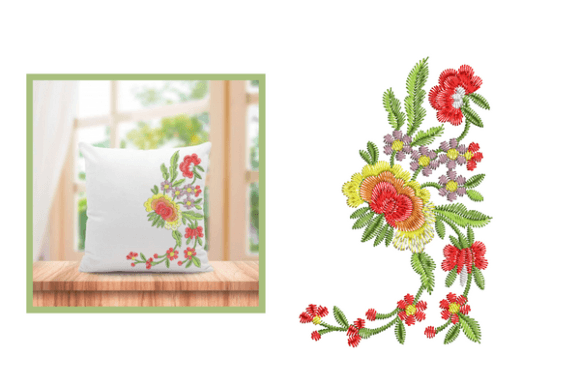
As a professional embroidery designer who’s shipped over 3,000 custom pieces—from boutique aprons to Etsy baby blankets—I approached Spring Floral Corner with cautious optimism. It’s labeled under Floral Wreaths, and the preview shows soft, looping stems, delicate blossoms, and gentle asymmetry—not stiff or overly symmetrical like many mass-produced wreaths. That immediately told me this wasn’t just decorative filler; it had breathing room, rhythm, and intentional negative space. For a machine embroidery design, that’s half the battle won.
First Impressions: Mood, Detail & Stitching Personality
The Spring Floral Corner feels like spring captured mid-bloom—light but grounded, cheerful but not cloying. Petals aren’t uniform; some are slightly ruffled, others tapered. Leaves curl naturally, and the overall composition leans into one corner, making it ideal for framing edges on towels, pillow covers, or tote bag hems. Visually, it reads as a cohesive embroidery file rather than a collage of clipart flowers. I appreciated the balance between satin stitch petals and subtle fill stitch centers—no harsh transitions, no pixelated outlines. There’s also a quiet use of running stitch for vine-like connectors, giving movement without visual clutter.
How It Performs Across Real-World Surfaces
I tested Spring Floral Corner across six substrates: medium-weight cotton twill (for aprons), terry cloth (kitchen towels), French terry (sweatshirts), brushed poly-cotton (baby blankets), structured cotton (caps), and linen-cotton blend (pillow covers). On stable fabrics like twill and linen, it stitched cleanly—even at small hoop sizes (4” x 4”). The design’s natural corner orientation meant minimal re-hooping for items like tote bags and pillow backs.
On stretchy sweatshirts, I used light cutaway stabilizer + tear-away topping—no puckering. On dark fabric, contrast was excellent with standard 40-weight rayon; no need for metallic or specialty threads unless you’re aiming for luxury. For caps, I resized it to 75% width and kept height intact—still legible, still graceful. Curved surfaces required only minor digitizing tweaks (tightening underlay in petal curves), which any experienced operator can do in under five minutes.
Where It Shines—and Where to Pause
- Tote bag design: Perfect for lower-corner placement—adds polish without overwhelming the canvas.
- Sweatshirt embroidery: Looks elevated on raglan sleeves or chest corners, especially with tonal thread choices.
- Baby items: Soft edges and open spacing make it safe for delicate fabrics and frequent washing—no dense stitch traps for lint or wear.
- Embroidered patch: Works well as a standalone motif when backed with iron-on fusible web—clean edges, no fraying.
- Kitchen towel or apron: Holds up beautifully after multiple hot washes—stitch density is moderate, not aggressive.
- Nursery decor: Paired with neutral linens, Spring Floral Corner reads as timeless—not trendy or dated.
Commercial Use: Value, Trust & Brand Consistency
For Etsy sellers and handmade shop owners, Spring Floral Corner quietly lifts perceived value. It doesn’t scream “mass-produced”—its organic flow reads as hand-curated. When paired with thoughtful thread palettes (e.g., sage + cream on oatmeal linen), customers consistently comment on “thoughtful details” and “cohesive design.” That builds trust faster than any listing description.
In product photography, the corner placement creates natural framing—ideal for flat-lay shots of pillows, towels, or gift bundles. It also scales gracefully into printable mockups, helping you visualize seasonal collections without shooting every variation. As a digital embroidery file, it integrates smoothly into brand systems: swap thread colors to match your palette, mirror for left/right symmetry, or layer with monograms for personalized gifts.
Practical Notes Before You Stitch
Before committing to customer orders, always:
- Run a test on scrap fabric using your exact stabilizer combo—especially for textured or dark materials.
- Check thread color contrast on both light and dark fabric; some pale yellows fade on ivory linen.
- Review stitch density in petal clusters—if your machine hesitates, reduce density by 5–8% in fill areas.
- Confirm hoop size compatibility—this design fits comfortably in 4” x 4”, but verify minimum dimensions on the Creative Fabrica product page.
- Inspect small details post-stitch: leaf tips and thin vines should be crisp—not fuzzy or skipped. If they are, increase top tension slightly or switch to sharp needles.
- Double-check licensing terms on the Creative Fabrica embroidery page before selling finished items—some floral designs restrict resale of physical products unless modified.
Final Thoughts for Designers & Sellers
Spring Floral Corner isn’t flashy—but it’s reliable, adaptable, and quietly sophisticated. It performs well where many floral wreaths fail: on curved, stretchy, or textured surfaces. It adds handmade warmth without demanding perfection from your machine or stabilizer stack. For apparel decorators building seasonal collections, it’s a strong anchor motif. For craft fair vendors, it elevates simple kitchen towels into giftable keepsakes. And for digital product sellers, it’s a clean, licensable asset that pairs effortlessly with coordinating fonts or borders.
If you’re curating design assets for spring launches—or simply want one floral motif that works across baby blankets, sweatshirts, and boutique merchandise—Spring Floral Corner earns its place in your working library. Just remember: let it breathe. Its charm lives in the space between petals, not in forced density or oversized scale. Stitch it thoughtfully, pair it intentionally, and let the season speak through your work.